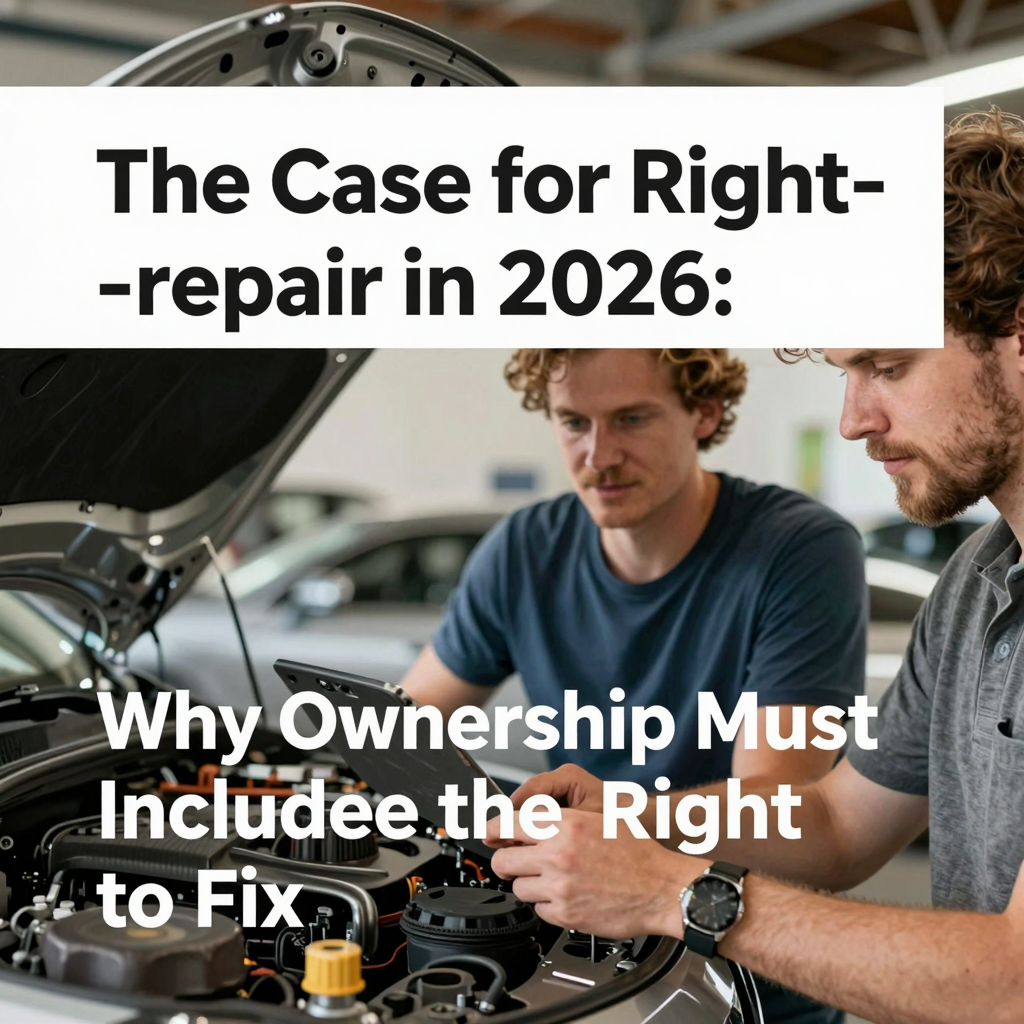
In 2026, the right-to-repair movement has moved from the fringes of consumer advocacy into the mainstream of public policy and corporate strategy. What was once a niche campaign led by independent repair shop owners and environmental activists is now a global conversation about ownership, sustainability, and economic fairness. As our lives become ever more dependent on smartphones, laptops, tractors, medical devices, and even smart home appliances, the question of who is allowed to fix these products—and at what cost—has become impossible to ignore. The case for right-to-repair in 2026 is no longer just about saving money on a cracked screen; it is about reclaiming the fundamental rights of consumers, reducing a mounting environmental crisis, and building a more resilient economy.
The stakes have never been higher. The average household now owns dozens of connected devices, many of which are designed with sealed batteries, proprietary screws, and software locks that prevent third-party repair. Manufacturers often argue that these restrictions protect safety, security, and intellectual property. Yet a growing body of evidence shows that these practices primarily protect lucrative service monopolies and accelerate the cycle of planned obsolescence. In 2026, as legislative victories continue to reshape the repair landscape, it is time to examine the full argument for right-to-repair: why it matters, what has changed, and what still needs to be done.
The Evolution of the Right-to-Repair Movement
The right-to-repair movement has deep roots in the early days of consumer electronics, when repair manuals and spare parts were readily available for everything from radios to washing machines. Over the decades, however, manufacturers began to restrict access to parts, tools, and diagnostic software. By the 2010s, the movement had gained significant traction, fueled by viral teardown videos, grassroots repair cafés, and consumer frustration with expensive authorized service programs. In the United States, states like Massachusetts led the way with automotive right-to-repair laws, while the European Union began pushing for broader ecodesign requirements.
By 2026, the movement has achieved a critical mass of legislative and cultural victories. The European Union’s Ecodesign for Sustainable Products Regulation now mandates that many categories of electronics be designed for repairability and that spare parts remain available for up to ten years after purchase. In the United States, several states—including New York, California, and Minnesota—have enacted comprehensive right-to-repair laws covering consumer electronics, home appliances, and even agricultural equipment. These laws require manufacturers to provide independent repair shops and consumers with access to the same parts, tools, and documentation that authorized repair providers receive. The momentum is undeniable, but the battle is far from over.
The Environmental Imperative: Addressing the E-Waste Crisis
One of the most compelling arguments for right-to-repair in 2026 is the staggering environmental cost of disposable electronics. The world generates over 60 million metric tons of electronic waste each year, making e-waste the fastest-growing solid waste stream on the planet. Much of this waste is driven by products that are technically repairable but practically disposable due to a lack of available parts, prohibitive repair costs, or software locks. When a five-year-old smartphone needs a new battery, but the manufacturer only offers the part through an authorized service center at a price close to a new device, the rational choice for many consumers is to replace the entire unit.
Repair is one of the most effective ways to reduce the environmental footprint of electronics. Manufacturing a new device consumes vast amounts of energy, water, and rare earth minerals. Extending the lifespan of an existing product through repair dramatically reduces the demand for new raw materials and prevents toxic substances like lead, mercury, and cadmium from leaching into landfills. A 2025 study by the European Environmental Bureau found that extending the lifespan of smartphones by just one year across the EU would save the equivalent of taking two million cars off the road in terms of carbon emissions. In 2026, the environmental case for repair has become an urgent climate imperative.
- Reduced raw material extraction: Repairing devices reduces the need for mining cobalt, lithium, and other critical minerals.
- Lower carbon emissions: Manufacturing accounts for the majority of a device’s lifetime carbon footprint; repair avoids that initial production cost.
- Less toxic waste: Proper repair keeps hazardous components out of informal recycling streams and landfills.
- Circular economy support: Repair is a cornerstone of the circular economy, keeping products and materials in use for as long as possible.
Consumer Rights and the True Meaning of Ownership
At its core, the right-to-repair debate is about what it means to own something. When you buy a product, you should have the right to use it, modify it, and repair it as you see fit. In 2026, however, many products are governed by restrictive end-user license agreements that technically make you a mere licensee rather than an owner. Manufacturers use digital rights management (DRM), proprietary software, and cloud-based authentication to control how devices are used and who can fix them. A farmer who purchases a $500,000 tractor may discover that they cannot diagnose an engine fault without proprietary software that only the dealer can access. A hospital technician may be unable to service a critical medical device because the manufacturer refuses to sell replacement parts to anyone outside its own network.
This erosion of ownership rights has real consequences. Consumers are forced to pay premium prices for authorized repairs or to discard products that could otherwise be fixed. Independent repair shops—often small, local businesses—are shut out of the market, reducing competition and consumer choice. In some cases, manufacturers have even disabled devices remotely after unauthorized repairs, a practice that has drawn sharp criticism from consumer protection agencies. The right-to-repair is not an attack on intellectual property; it is a defense of the traditional rights that consumers have always expected: the right to use what you own, the right to choose who repairs it, and the right to keep a product working as long as possible.
Economic Benefits: Repair as a Driver of Local Economies
The economic case for right-to-repair is often overlooked, but it is compelling. Repair is inherently local. Unlike manufacturing, which has been largely offshored, repair work must happen where the product is used. This means that every independent repair shop, every refurbisher, and every technician trained in electronics repair contributes to local job creation and economic resilience. In 2026, the repair economy is growing rapidly, driven by both legislative changes and consumer demand for affordable alternatives to manufacturer-authorized service.
A thriving repair sector benefits consumers by lowering the total cost of ownership. When independent repair is allowed, prices for common repairs like screen replacements, battery swaps, and software troubleshooting fall significantly. Competition forces manufacturers to offer more reasonable pricing for their own authorized services. Furthermore, the availability of repair extends the useful life of products, meaning consumers can defer expensive replacements and redirect their spending to other areas of the economy. Small businesses that provide repair services often employ people with specialized technical skills, and those jobs cannot be easily automated or outsourced.
- Local job creation: Repair shops employ technicians, customer service staff, and logistics workers in communities around the world.
- Lower consumer costs: Independent competition drives down the price of common repairs, saving households hundreds of dollars per year.
- Support for small businesses: Right-to-repair laws level the playing field, allowing independent shops to compete with authorized dealer networks.
- Refurbishment and resale markets: Access to parts and documentation makes it easier to refurbish used devices, creating a thriving secondary market.
The Legislative Landscape in 2026: Progress and Momentum
By 2026, the right-to-repair movement has secured significant legislative victories across multiple jurisdictions. The European Union has emerged as a global leader, with the Right to Repair Directive and the Ecodesign for Sustainable Products Regulation establishing a framework that prioritizes repairability, durability, and access to spare parts. Under these rules, manufacturers must make common spare parts available to consumers and independent repairers for up to ten years after a product is discontinued, and they must provide repair information in a format that is accessible and understandable.
In the United States, the state-by-state approach has yielded a patchwork of laws that nonetheless signal a clear trend. New York’s Digital Fair Repair Act was one of the first to cover consumer electronics, while California’s Right to Repair Act expanded protections to include appliances and agricultural equipment. As of 2026, more than thirty states have introduced right-to-repair legislation, and several federal bills are under active consideration in Congress. The Fair Repair Act at the federal level would create a national standard, requiring manufacturers to make parts, tools, diagnostics, and documentation available to independent repair providers and consumers on fair and reasonable terms.
Global Progress Beyond the US and EU
The movement is not confined to Western markets. Countries such as India, Brazil, and South Africa have introduced or passed repair-friendly regulations, often driven by concerns about e-waste and the need for affordable technology access. In India, for example, new rules require smartphone manufacturers to provide spare parts for at least seven years and to make repair manuals available in local languages. These global developments reflect a growing consensus that the right to repair is a consumer right, not a regulatory burden.
Industry Resistance and the Slow Shift Toward Repair-Friendly Design
For years, major technology and appliance manufacturers resisted right-to-repair laws, arguing that they would compromise device security, expose trade secrets, and lead to unsafe repairs. Some companies lobbied heavily against legislation, funded studies claiming that repair restrictions protect consumers, and implemented increasingly sophisticated software locks to prevent unauthorized fixes. In 2026, however, that resistance is beginning to crack. Several major manufacturers have announced voluntary repair programs, including expanding access to original parts, tools, and repair guides for popular products.
This shift is driven by a combination of regulatory pressure, consumer backlash, and the realization that repair can be a profitable business in its own right. Companies that once fought repair now see an opportunity to sell parts, offer repair subscriptions, and build brand loyalty among consumers who value longevity. At the same time, some manufacturers continue to resist, particularly in sectors like agriculture and medical devices, where proprietary software and service contracts remain highly lucrative. The challenge for 2026 and beyond is to ensure that voluntary programs are meaningful and that they do not simply replace legal obligations with marketing gestures.
Security Claims: A Closer Look
One of the most persistent arguments against right-to-repair is that providing access to diagnostic tools and software will make devices more vulnerable to hacking and cyberattacks. Security researchers have repeatedly debunked this claim, pointing out that security through obscurity is not a sound strategy. In fact, many security vulnerabilities are discovered and patched by independent researchers who need access to device internals. Properly implemented right-to-repair laws can include safeguards, such as requiring secure authentication for software access and ensuring that safety-critical components are clearly identified. The key is to distinguish between legitimate security protections and anti-competitive practices that use security as a pretext.
The Role of Technology: Modular Design and the Future of Repair
The right-to-repair movement is not just about access to parts and tools; it is also about designing products that are easier to repair in the first place. In 2026, a growing number of products are being engineered with repairability in mind. Modular smartphones with user-replaceable batteries and cameras are entering the market, while laptops are returning to designs that allow memory and storage upgrades without soldering. This shift is partly driven by regulation, but it is also a response to consumer demand for products that last longer and waste less.
Technology itself is also making repair more accessible. Online repair platforms, video tutorials, and community forums have democratized the knowledge required to fix everything from refrigerators to game consoles. Diagnostic tools that were once only available to authorized dealers are now being sold directly to consumers, often through online marketplaces. In 2026, a consumer with a smartphone, a screwdriver, and an internet connection can often diagnose and fix a problem that would have required a costly service visit just a few years ago. This technological empowerment is a key driver of the repair revolution.
Challenges Ahead: Enforcement, Parts Availability, and Software Updates
Despite the progress, significant challenges remain. Passing a right-to-repair law is not the same as enforcing it. Manufacturers may technically comply with the letter of the law while making parts prohibitively expensive, providing documentation that is incomplete or difficult to use, or continuing to use software locks that block third-party repairs. Regulators in 2026 are increasingly focused on ensuring that right-to-repair laws are effective in practice, not just on paper. This includes setting standards for reasonable pricing, requiring manufacturers to sell parts at prices that do not make repair uneconomical, and ensuring that independent repair shops have access to the same diagnostic capabilities as authorized dealers.
Another major challenge is the ongoing tension between repair and software updates. Many modern devices are controlled by software that is constantly updated. While updates are essential for security and functionality, they can also introduce features that reduce performance, require new hardware, or disable repaired components. In 2026, consumer advocates are calling for transparency in software updates, including clear disclosure of what an update will do and the ability to roll back harmful changes. The right-to-repair must evolve to include the right to keep a device functional even as software evolves, without being forced into obsolescence.
Conclusion: The Future Belongs to the Fixers
The case for right-to-repair in 2026 is overwhelming. It is an environmental necessity, a consumer right, an economic opportunity, and a matter of basic fairness. The movement has achieved remarkable progress over the past decade, but the work is not finished. As technology continues to advance and devices become even more integrated into every aspect of daily life, the principles of repairability, longevity, and user control will become ever more important. The right-to-repair is not about turning back the clock; it is about ensuring that the products we depend on are designed for the future we actually live in—a future of finite resources, growing environmental awareness, and empowered consumers.
In 2026, the question is no longer whether we should have the right to repair our own devices. The question is how quickly manufacturers, regulators, and consumers will embrace that right and build a world where products are made to be fixed, not thrown away. The fixers are no longer on the fringe. They are the future.
Leave a Reply